
Dawood Ibrahim is wanted in India to face the law of the land for carrying out serial blasts in Mumbai in 1993 in which scores of people were killed and injured.

Until Delhi and Beijing resolve outstanding border issues within an accelerated time frame, standoffs like Doklam will be repeated across various peaks along the Himalayas, says Mathew Maavak.

Khan, who is believed to have the backing of the powerful military, has vowed to make a 'Naya Pakistan' which would be an Islamic welfare state.
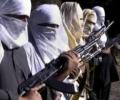
A new version of jihad is attracting "small but steady stream" of Indians to join Islamic State movement in Syria, Former National Security Advisor M K Narayanan has warned.

Internal strife and tribalism is endemic to Afghanistan, notes Colonel Anil A Athale (retd).

Seeking to wriggle out of the FATF's grey list, Pakistan has imposed tough financial sanctions on 88 banned terror groups and their leaders, including Hafiz Saeed, Masood Azhar and Dawood Ibrahim, by ordering the seizure of all of their properties and freezing of bank accounts, a media report said.
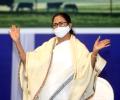
Though the BJP is running too close for comfort, populist schemes and support among Muslims may help Mamata Banerjee overcome the challenge, observes Aditi Phadnis.
Vicky Nanjappa on the challenges that the new Home minister faces
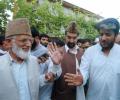
Officials said both the factions of the Hurriyat are likely to be banned under Section 3(1) of the Unlawful Activities (Prevention) Act, or the UAPA, under which "if the Central Government is of opinion that any association is, or has become, an unlawful association, it may, by notification in the Official Gazette, declare such association to be unlawful."

'Muslims, like people of all other faiths, are quite comfortable with the idea of nationalism and democracy today. But are they following Islam in its spirit? That is a different question.'

The Muslim politics in Kerala has taken a turn with the advent of the Popular Front, a political party floated with the support of four Islamic organisations of South India.

'So why didn't the police make it very clear that this is the line of investigation, this is what we are doing.' 'Nobody knows what kind of report was done.' 'Was she checked for (sexual assault)?'

'India is a major target for ISIS and Al Qaeda because it has a very large Muslim Diaspora, regular conflicts with a Muslim country and experiences violent clashes between Hindus and Muslims on a regular basis.' 'This provides for a very stable breeding ground for jihadist radicalisation and recruitment.'
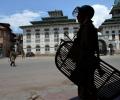
The group was banned for five years under anti-terror law on grounds that it was "in close touch" with militant outfits and is expected to "escalate secessionist movement" in the state.
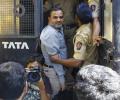
On Wednesday, the special MCOCA court in Mumbai awarded death sentences to Kamal Ahamed Ansari, 37, Mohd Faisal Shaikh, 36, Ehtesham Siddiqui, 30, Naveed Hussain Khan, 30 and Asif Khan, 38, for the role they played in the 7/11 Mumbai train blasts, which claimed the lives of 188 people.
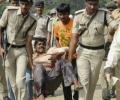
The Patna attack was just the beginning, the alleged SIMI terrorist told NIA agents. His organisation has resolved to attack Narendra Modi wherever possible.

'Lord Ram's history has reached Indonesia, but not Owaisi's home.'

Holding that popularity of language was linked with financial might of any country, Prime Minister Narendra Modi on Tuesday said that importance of Hindi was set to increase with India marching rapidly towards economic prosperity.

Armed forces and the police can only ensure that violence is kept under control but for any kind of lasting peace, politicians will have to find an answer to the perception that the Indian State is anti-Islam. Therein lies the biggest challenge to the Modi government, says Colonel Anil A Athale (retired).

The Taliban is highly pragmatic and would regard it wasteful to resume military offensive to capture Panjshir. The Taliban's preference, historically, has been to keep the military option as the last resort, explains Ambassador M K Bhadrakumar

The case took a twist when the defence lawyer sought to call Indian Mujahideen co-founder Sadiq Sheikh as a defence witness after he told the police in 2008 that IM members were responsible for all the blasts that had occurred in India since 2005 including the July 11, 2006 train blasts.
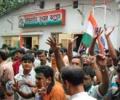
In another display of the politics of threat in West Bengal, a ruling Trinamool Congress Member of Legislative Assembly openly threatened to "behead" a Congress leader in Birbhum district.
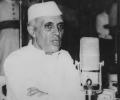
'Nehru's inability to take religion seriously as a category led to serious errors of judgement in his dealings with the Muslim League, and later, also with the Hindu right.'

China's growing concern over the existence of terror training camps in Pakistan, establishment of an energy corridor and firming up of nuclear energy cooperation will come up for discussion during Prime Minister Nawaz Sharif's talks with the Chinese leadership in Beijing.

The battle against militants fighting for separation of China's volatile Xinjiang province, bordering PoK and Afghanistan, is getting "tougher, fiercer and crueler than ever" due to the revival of pan-Islamic extremist groups, top Chinese leaders from the province said.

Here are some of the reactions to the Supreme Court verdict on Ayodhya.

'Tamil Nadu is a paradox. We have more places of Hindu worship per square kilometres than any other place in the world. 'We break more coconuts for religious reasons everyday than any other place in the world.' 'At the same time, we also have a very strong Periyar-infused movement of rationalism.'

'China's growing nexus with Pakistan and the two countries' unresolved territorial disputes with India continue to pose a formidable national security threat to India,' says Brigadier Gurmeet Kanwal (retd).

'It is folly to think that religious-identity-based politics and a flourishing economy can co-exist in a diverse society.' 'We can fight and kill each other, or fight together and kill poverty. We cannot do both,' says Dasarathi G V.

Defying prohibitory orders, protests were held in Delhi, Bengaluru, Hyderabad and several other cities. Protesters, mostly students and activists, were detained on a large scale in national capital and other places.

Dreaded Islamic State militant group has appointed a breakaway Taliban commander as its chief in Khurasan, a historic name used by militants for an area covering Afghanistan, Pakistan and parts of India.
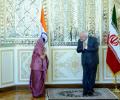
India's low passion, very cautious, relationship with Iran of the last 36 years awaits transformation, says Lieutenant General Syed Ata Hasnain (retd). Prime Minister Modi's visit cannot be a negotiating event; it is a symbolic one to strengthen the politico-diplomatic relationship.
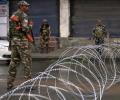
All things taken into consideration, the Taliban statement on Kashmir portends trouble ahead. The Taliban is notorious for doublespeak and when it says there is no link between the Kashmir issue and the Afghan settlement, the opposite must be taken into account as well, points out Ambassador M K Bhadrakumar.

In 2012, then Gujarat chief minister Narendra Modi gave an interview wherein the then Gujarat CM spoke about the possibility of and 'Akhand Bharat'.

'The jurisprudence of a modern secular State has to be strictly rational.' 'Rather than aastha and aqeedah, our jurisprudence as well as the executive and legislature have to act in accordance with Constitutional rationality,' argues Mohammad Sajjad.

'Jinnah developed a belief that Gandhi had stolen the tag of the leader of the Indian people from him and that he later used religion to reduce Gandhi's idea of a united India to naught was his revenge.'

'But India, increasingly, is not that far behind, which is a story I never expected to tell.'

'We will continue to support Pakistan as we find no difference. They used to be Indians once upon a time, Yasin Bhatkal told his interrogators, even as Indian Mujahideen has largely transformed into a homegrown terror outfit with tacit support from across the border, reports Vicky Nanjappa.

Ayodhya Nagar Nigam corporator Haji Asad hoped that Kashi and Mathura issues will not be raked up after the CBI court ruling.

All Pakistani moves towards peace will be seen as tactical compromises, to be abandoned when the situation changes, observes Colonel Anil A Athale (retd).
